The Horror Novel as a Means to Conversion

By Frederick Woodward The horror novel is a unique subset of the fiction genre. In some ways, it can be understood as confronting the whole of reality more directly than many other types of storytelling, for it deals more intimately with the negative constants of our existence: evil, corruption in men, and the perversion of the natural order. The intent here is not to disabuse … Continue reading The Horror Novel as a Means to Conversion
Libraries and Why You Should Care About Them

By Caitlin Filep There are few things that soothe me more during the crush of finals week than going down to one of the stacks in Purgatory and just sitting on the floor among the books. Most times it’s the children’s section for the nostalgia–I’ll often crack open an illustrated Harry Potter or a Percy Jackson book and lose track of time–but sometimes I’ll venture … Continue reading Libraries and Why You Should Care About Them

A Harbor for the Winter: Art, Snow, and Suffering

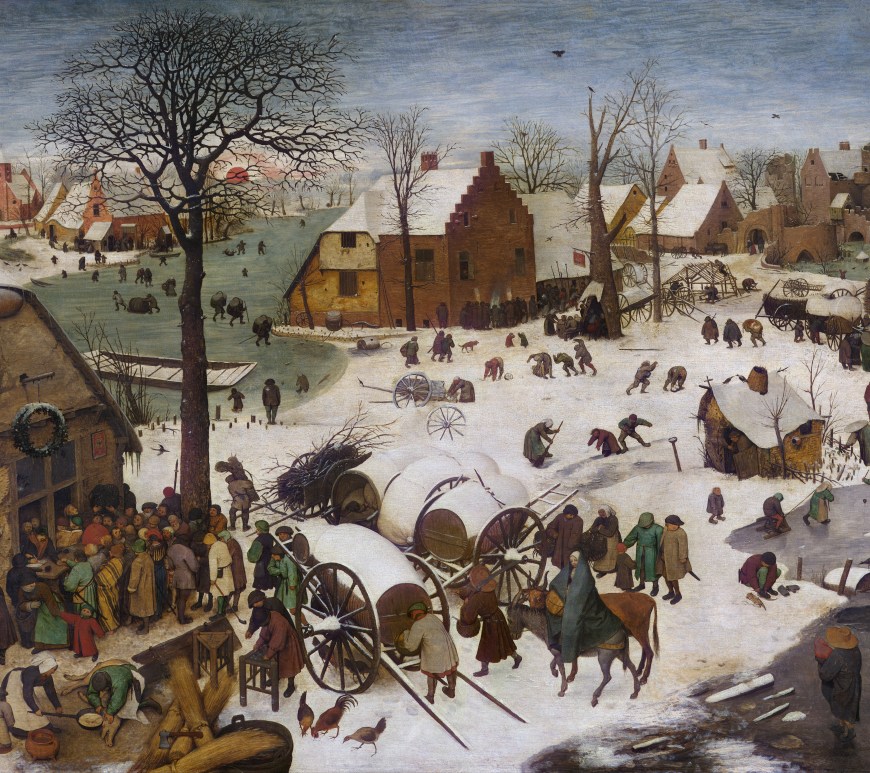
By Campbell Collins “About suffering they were never wrong, / The Old Masters.”  I love these lines, the opening of W.H. Auden’s “Musée de Beaux Arts.” In the poem, Auden describes the paintings of the Brueghels, the Masters who understood suffering so well. He references their depictions of a Dutch Mary, head bowed beneath a blue robe, trudging ignored in the cold and almost hidden … Continue reading A Harbor for the Winter: Art, Snow, and Suffering

Gregory Alan Isakov and Rainer Maria Rilke on the Quiet Things of Life

“ Oh blessed rage for order…The maker’s rage to order words of the sea…”   ~ Wallace Stevens One of Augustine of Hippo’s ways of understanding the human heart sounds paradoxical at first: a man can walk around the earth, but he cannot ever circumscribe his own heart. Rather than debate whether or not this is the case, I am going to take this as … Continue reading Gregory Alan Isakov and Rainer Maria Rilke on the Quiet Things of Life

The Writer as Artist: On Transience and the Joy of Words

Throughout my academic career, I have viewed writing as a means by which I can paraphrase, convey, and analyze other people’s ideas. I never attempted poetry or creative prose, or anything outside of academic essays for that matter, because the thought that those styles of writing were something I could do or something worthwhile had never even crossed my mind. As a writer, I was … Continue reading The Writer as Artist: On Transience and the Joy of Words

Making Shelfspace for the YA Genre

Young people of the twenty-first century do not just play video games and sit on their phones and engage in debauchery—they also read. Some quick Google searches show that an estimated 447 million copies of books in the Harry Potter series have been sold as of 2016. Similarly, about 120 million copies of the Twilight saga, and 65 million copies of The Hunger Games. This … Continue reading Making Shelfspace for the YA Genre

The Surrender of Plot: Uncovering the Divinity of Storytelling

I stood in the bookstore, gaping at the vibrant colors and whimsical text scrawled across hardcover book jackets. Each book made a pretty picture on the shelf, but after years of book store prowling, I knew that few, if any, offered much beyond aesthetic. I wandered into the classics section and ran my hand along the spines of compendiums, comprehensive volumes, and special editions. What … Continue reading The Surrender of Plot: Uncovering the Divinity of Storytelling

“Milestones of Earth Residence”: On Poetry of Place

When I drive home from Hillsdale, I turn the radio to 93.9 as I pass Ann Arbor. It’s just close enough for the signal to come through, and for the rest of the way back to Detroit, I listen to the sound of my teenage years and my college summer commutes. Broadcasting from across the river, the Canadian station plays alt-rock hits until they wear … Continue reading “Milestones of Earth Residence”: On Poetry of Place

“The Riddle We Can Guess”: On Clarity and Ambiguity in Writing

“The riddle we can guess / We speedily despise.” —Emily Dickinson, #1222 I was lying in the backseat of the car on an early October day in 2014, waiting while my mom grabbed a few things from the grocery store. It was probably very hot, as Tennessee autumns tend to be, but all I can recall about that moment was the book, William Faulkner’s The Sound and … Continue reading “The Riddle We Can Guess”: On Clarity and Ambiguity in Writing