
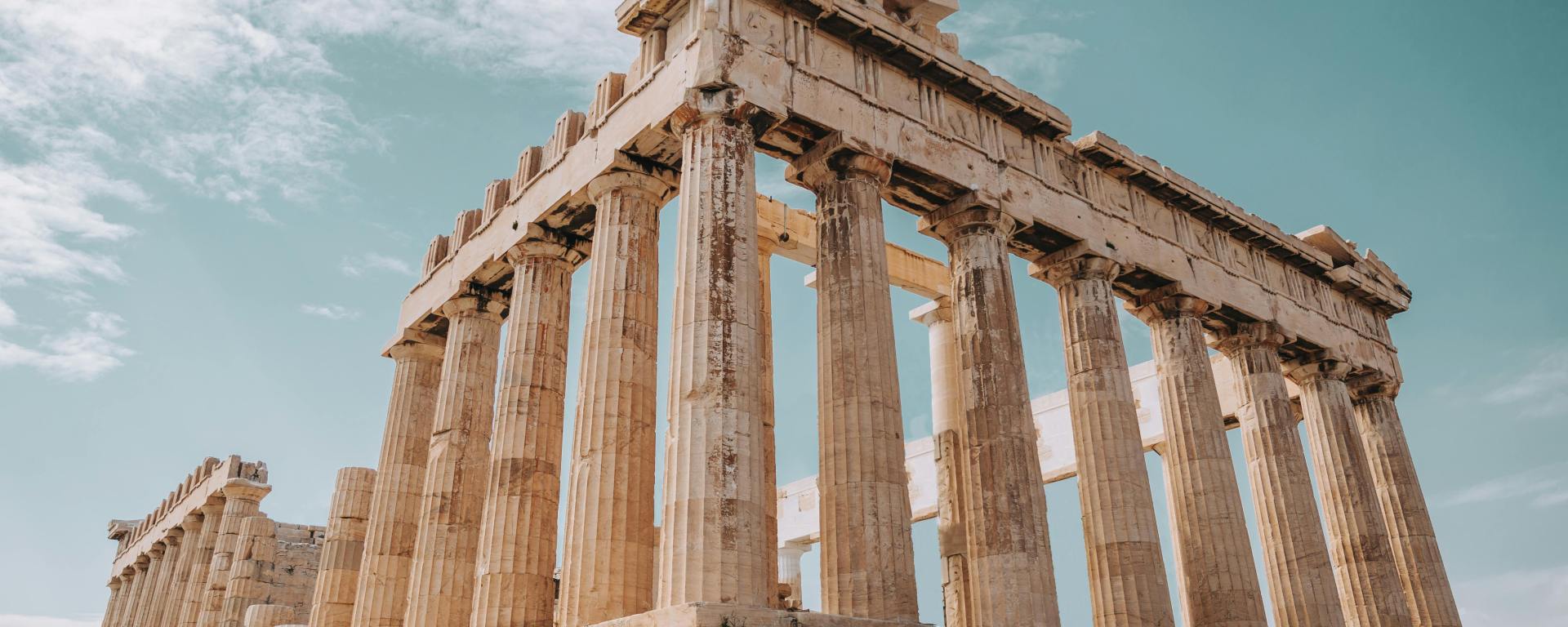
In this Forum interview, Professor of History Paul Rahe sat down with Sophia Mandt to discuss his interactions with renowned academics while an undergraduate, his criticisms of the modern higher education system, and more.
In your youth, you had the opportunity to study under well known academics such as Allan Bloom and Donald Kagan. What are some of the most profound or significant things that those men taught you?
Well, in both cases, their courses concerned ancient Greece. Bloom had just translated Plato’s Republic. We were reading it in manuscripts that were produced, not by a Xerox machine (there were none), but by another kind of copier. The Republic arrived halfway through the course, as he had then published the book. With Kagan, we were reading Thucydides and thinking about the Peloponnesian War and so forth. Getting an education is stepping outside of one’s own world, managing it differently, and looking at it from the outside – seeing ourselves, our way of life, our preferences, from the perspective of those who do not share them. The ancient Greeks, I think, offer a particularly good perspective – martial, not commercial, philosophically oriented, not practically oriented. And so it opened up visas – a world out there that has people just like us, but a way of life that’s very different. And it allows one to ask the question: is their way of life superior to ours?
The great danger is going off to college and thinking you know it all and simply being reinforced in the prejudice of one’s own time and place. The purpose of an education, a liberal education, is to be liberated from time and place and to be able to step back and judge the prejudices of our time against alternatives that we may not otherwise be aware of. From Kagan, I learned a concern with national defense, with war, with what it is that holds a society together with these entities. He’s extremely good on those topics and on how easily things can go wrong. Bloom taught me how to read: which is to say, to read in a penetrating manner in which you’re always aware that the author of a book or a pamphlet or a speech is up to something, trying to persuade you or to move you in a certain direction or teach you something, and so you always have to read critically. For example, if you hear a speech by a political figure, it’s good to step back and ask, what’s he up to? Because the task of a rhetorician is to take you from where you are to somewhere else. A speech like that almost always starts by reinforcing, by making you comfortable, by repeating a series of things you already agree with, and then by trying to show you that you can’t agree with that series of things without thinking this other thing, which you do not think ahead of time. So it’s manipulative or informative at the very least. And if you just sort of pick it up and read it, you may miss the fact there’s a drama going on.
There is something taking place when you read a newspaper. There used to be newspapers, but they’re pretty much gone now. When there were newspapers, you’d have a story, and the story would be based upon some bit of information that came the journalist’s way – very often someone in the political world telling him something. So the first question is, who told him and why? What are they trying to do? And what is the journalist trying to do? What is his editor or her editor trying to do? And if you read it this way, you read every news story as a kind of political intervention calculated to achieve a certain end. And the other thing is, you read pieces of literature with an eye to what’s being implied. You ask, what is it? What’s being said in between the lines?
For example, Antigone. The lead character, Antigone, is extremely passionate in her speech and appeals to certain principles that the Greeks held dear with regard to families, with regard to households, with regard to your duty to other people in your family, which she presents in terms of general principles at the very end of the play when there’s no audience. I’m not talking about us as an audience, but about the chorus, Prion, and the other figures in the play. She gives a soliloquy. The issue is about burying her brother, and she says, ‘If I had a husband or a child, I wouldn’t be doing this.’ It’s a repudiation of the general principle that she’s made the central point of all of her arguments. And you can read right past it. We have a tendency to sleep-walk through texts and to read past really important things that are there. The truth of the matter is, she doesn’t believe a word of what she has said in public. And you know you have to ask: to whom do you have a greater obligation? To your brother, to your husband, to your child? Almost anyone with children would put children first, husband second, brother, third. But she puts brother first and gives no concern for child or husband. There’s something a little twisted about that.
And then her name means “hostile to” – “anti-gonay,” which is the Greek word for “procreation” or “generation.” Our word “gonad” is related to it. In the Jewish Bible, a man is supposed to leave his parents and cleave to his wife. But she’s not willing to leave the family of her birth. So there’s something very wrong there, which today’s readers and the freshmen I teach every year just waltz past without seeing it. Now part of the story with freshmen is that they’re not married and they don’t have children. They have siblings. They’re close to them, so her appeal is especially powerful with them, but it also means they just don’t read carefully enough. The author wanted you to read carefully enough. Antigone turns out not to be well, to be a tragic hero, who maybe can have a terrible flaw that is the cause of the disaster. It doesn’t mean she’s wrong about wanting to bury her brother, but it means that her adoption of that position stems from something that’s not right.
Allan Bloom taught me to keep your eyes open when you’re reading. Especially when you’re reading a work by a great artist or a great philosopher or a great historian, there’s stuff going on and you’re being led on. So that I studied with those two people myself for a year, that was a great experience, and I knew them both until they died, which, in Kagan’s case, was not so long ago. I wrote an obituary for him.
What are some of the most widespread misconceptions that you think our culture has about the American Republic, and how do these misconceptions persist?
I don’t know if misconception is the central problem. Ignorance – great, great ignorance – seems to me to be more widespread. The American Republic is an astonishing achievement, fragile from the very beginning. It’s amazing that we came out of the Revolutionary War intact, and it was mainly because of the French and the Spanish that we did. And it was equally amazing because the colonies, which were really prior to the revolution, had nothing to do with one another. If you were from Philadelphia, you were more likely to meet a Bostonian in London than anywhere on the North American continent, because they didn’t travel up and down the seaboard. Everything pointed towards London, and they had different religious backgrounds, different cultures, different ethos and attitude. The guys in Virginia were aristocrats. They dressed like aristocrats. They carried swords. The people from Boston were the grandchildren or great grandchildren of the Puritans. They dressed simply. They liked bad food, just like the people in the Midwest who were their descendants. They were playing people, as opposed to Cavaliers. For those groups to get along is fairly remarkable, and to get the Constitution written and then through the ratifying conventions was an achievement. And had it not been for that, the country would have disappeared, so there’s a kind of astonishing achievement.
The other thing is, it’s the first republic founded on the principle that slavery is unjust, which created a huge problem, because half of the country was dependent on slavery for its economy. And how do you get out from under an evil like slavery? You could free the slaves, except that you’re bankrupting yourself when you do that, and you may be setting the stage for a racial war. The slaves you free have some reason to hate you, and they’re living in the same place. And so through most of the North, the slaves were freed, but it was easy. There weren’t very many. They were more a matter of prestige working in your home than they were a source of income and wealth.
Is there a particular historian whose work you wish was more broadly studied and understood? And why?
He thought he was a Marxist – Eugene D. Genovese. He wrote a book called Roll, Jordan, Roll: The World the Slaves Made. I think it’s a masterpiece, and it’s a masterpiece that looks at the world in the old south from the perspective of the slaves as agents, and the evidence that he’s collected is just phenomenal. I knew him very well. When I was a beginning assistant professor, I called him and asked him to be on a panel at the American Historical Association. He said, “I can’t. I’m on two panels already, but I have a wife.” “Can I talk with her?” So I talked with her. And then they invited me up to Rochester, which was where they were. And in the course of a somewhat drunken dinner, I said, “Gene, I don’t think you’re a Marxist at all. I think you’re a Bolshie Aristotelian.” He died a Catholic, and he and his wife became the godparents of my oldest child. That’s a book that was a big hit when it came out, and I think it’s quasi-forgotten now, and that’s a shame. Another book I would recommend is Ronald Syme’s The Roman Revolution. It’s just a brilliant account of the rise of Augustus.
What is a historical figure you wish more people knew about?
Otto Von Bismarck. He’s the one who created Germany. He was the principal minister in Prussia, and by maneuvering, he put the whole thing together. A man of astonishing brilliance. And had his advice been followed, there might not have been a World War One.
 Hillsdale Forum